

“As the Year Closed, the Warnings Opened”: Inside Primate Ayodele’s 2025/2026 Prophecy Briefing
By Arikawe Femi, The People’s Voice Nigeria News
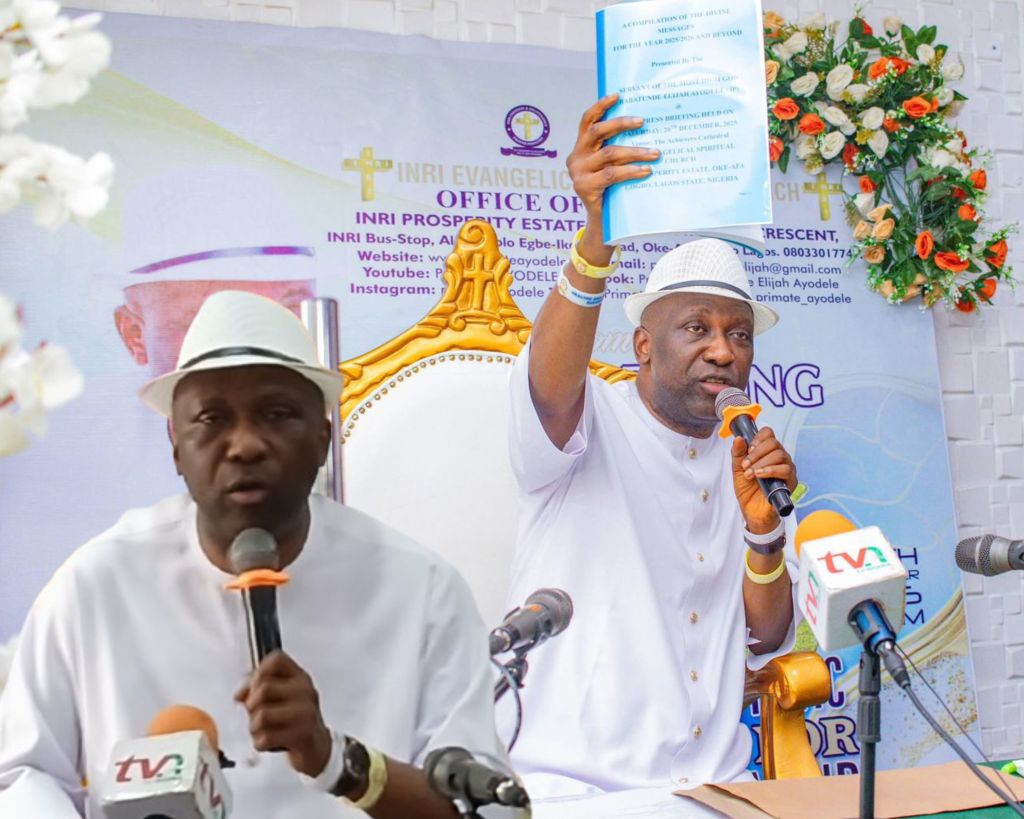
The atmosphere inside the hall was solemn, charged with expectation, and heavy with silence as Primate Babatunde Elijah Ayodele mounted the podium. It was December 20, 2025, and the annual World Press Conference of the INRI Evangelical Spiritual Church had once again drawn journalists, clergy, political observers, and security analysts from across Nigeria and beyond.
There were no dramatic theatrics. No background music. No chants. Just a man, a microphone, and a message he repeatedly insisted was “not mine, but God’s.”
“I can only tell you what the Lord tells me,” he said, invoking the biblical prophet Micaiah as he opened the address .
A Prophet’s Burden, a Nation’s Crossroads
For over two decades, Primate Ayodele has built a reputation as one of Africa’s most controversial prophetic voices celebrated by followers, scrutinized by critics, but never ignored. At this year’s briefing, the weight of that history was unmistakable.
Dressed simply, he spoke deliberately, often pausing to allow his words settle. When he spoke of betrayal, disunity, and hardship, the hall fell into complete stillness. When he warned of political desperation ahead of 2027, pens scribbled furiously across notepads.
“This is not a season for parties,” he warned. “Nigerians will vote for integrity, pedigree, and substance not slogans.”
The statement drew murmurs across the room.
Tinubu, Power, and the Storm Ahead
A significant portion of the address focused on President Bola Ahmed Tinubu and the fragile political terrain leading into the 2027 elections. According to the Primate, internal betrayal not opposition firepower, poses the greatest threat to the current administration.
He warned that some northern elders would turn against the President, that trusted allies would secretly work for opposition forces, and that desperation on all sides would fuel vote buying, propaganda wars, and street unrest .
“The more he pacifies,” Ayodele said, “the more some people will destroy his efforts.”
The warnings extended to institutions. He foresaw attacks on INEC officials, rowdy legislative sessions, and internal fractures within Nigeria’s security architecture remarks that drew uneasy glances among senior journalists present.
Economy, Banks, and Corporate Tremors
Beyond politics, the prophecies ventured deep into Nigeria’s economic bloodstream.
Ayodele warned of turbulence in the banking sector, citing Treasury Bills as a potential trigger for distress. He named compliance pressures on major financial institutions and predicted leadership changes within banks, even suggesting grief within the Central Bank hierarchy .
Telecommunications companies were not spared. He predicted network shutdowns, vandalized infrastructure, tariff hikes, and workforce reductions across major operators, a forecast that immediately sparked quiet discussions among business correspondents in attendance.
Security, Faith, and a Call for Vigilance
The most sobering moments came when the Primate turned to security.
He warned of escalating kidnapping tactics, ambushes on military formations, attacks on political convoys, and threats to educational institutions. His call was direct: churches, mosques, universities, and public facilities must strengthen security immediately.
“We must not be careless,” he said. “Prayer is not a substitute for vigilance.”
The hall remained silent.
Global Flashpoints and Prophetic Geography
From Africa to Asia, Europe to the Middle East, the prophecies painted a volatile global picture political instability in the UK, escalating US-China tensions, crises in Taiwan, North Korea, Venezuela, and prolonged conflict in Gaza .
He also warned of earthquakes, floods, aviation incidents, and natural disasters, urging governments to prepare rather than react.
2026: A Narrow Bridge, Not a Wide Road
As the briefing moved into 2026 projections, Ayodele emphasized misunderstanding, misinformation, and governance backlash. While acknowledging that Tinubu’s tax reforms could be beneficial, he warned they would be poorly communicated and fiercely resisted.
He also issued personal warnings to governors, traditional rulers, media professionals, entertainers, and religious leaders, underscoring what he described as a “year of exposure.”
“Secrets will come out,” he said quietly.
No Applause, Just Questions
When the address ended, there was no applause. Instead, there was a long pause.
Then the Primate invited questions.
Journalists rose slowly not in excitement, but with the measured urgency of people aware that what had just been spoken could shape headlines, policies, and public discourse in the months ahead.
Whether one believes the prophecies or not, one fact was undeniable as attendees filtered out of the hall: the warnings had been issued, the record had been set, and the nation had been put on notice.
History, as always, would be the final judge.
