

Documents Raise Questions as OSOPADEC Chairman Poroye Linked to ₦90 Million Payment After Controversial Signatory Change
By The People’s Voice Nigeria News
The Ondo State Oil Producing Areas Development Commission (OSOPADEC), under the leadership of its Chairman, Prince Biyi Poroye, has become embroiled in a web of allegations bordering on corruption, internal crisis, financial mismanagement, and the alleged manipulation or forgery of a board resolution.
The unfolding controversy has cast a shadow over the Commission barely months after Governor Lucky Orimisan Aiyedatiwa inaugurated the new OSOPADEC board on June 16, 2025. At the time, expectations were high among oil-producing communities across the state that the new leadership would usher in transparency, stability, and accelerated development. However, more than seven months later, those expectations appear largely unmet, as the Commission is now grappling with persistent internal disputes, stalled projects, and growing public distrust.
For the 2025 fiscal year, OSOPADEC received a budgetary allocation of ₦33.8 billion, earmarked to address infrastructure deficits, environmental degradation, and socio-economic challenges confronting oil-producing communities. Despite this substantial allocation, there is little evidence of commensurate development on the ground, with many communities reporting abandoned projects and minimal intervention.
Central to the crisis is an alleged internal power struggle over financial control within the Commission. This is said to be in clear contradiction of the OSOPADEC Establishment Law (2003) and its Amendment Law (2024), particularly Part II, Section 8(II)(a), which unequivocally designates the Secretary as the Accounting Officer of the Commission. Sources familiar with the Commission’s operations allege that disagreements over financial authority have crippled decision-making and paralyzed key development initiatives.
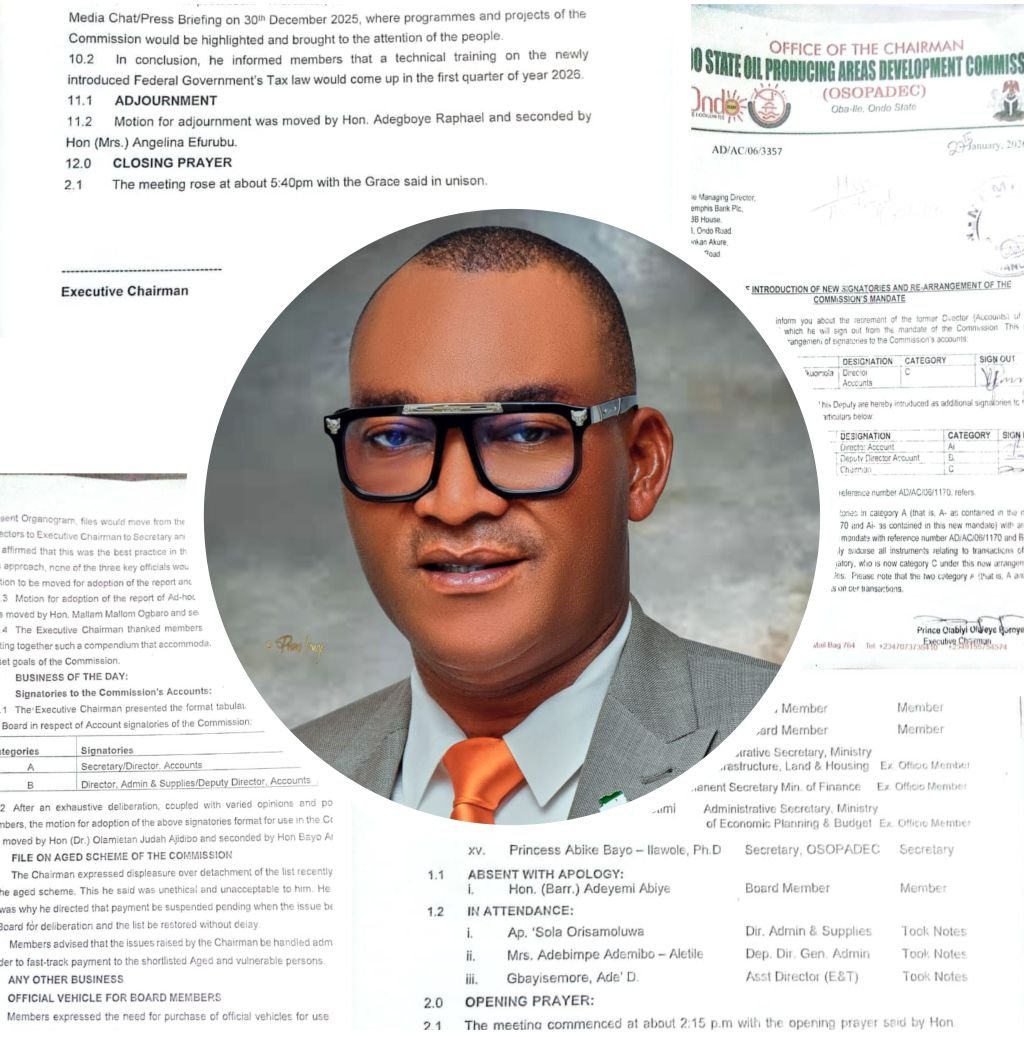
Documents obtained by our reporters shed further light on these claims. Official minutes show that the OSOPADEC Board last held a properly constituted plenary meeting on Monday, December 29, 2025, at the Commission’s headquarters in Oba-Ile, Akure North. The meeting commenced at about 2:15 p.m. and adjourned at approximately 5:40 p.m. It was attended by the Executive Chairman, Executive Directors, board members, the Secretary of the Commission, and ex-officio representatives from key state ministries, confirming that the board had quorum and that decisions taken were valid and binding.


Crucially, the minutes reveal that the issue of “Signatories to the Commission’s Accounts” was formally discussed under Item 7.1 of the Business of the Day. After extensive deliberations, the board adopted a specific signatory structure, designating the Secretary and senior finance officers as authorised signatories to the Commission’s bank accounts. The motion was duly moved, seconded, and adopted by the board.
The same documents do not indicate that the board authorised any post-meeting alteration of the approved signatory structure, nor do they reflect the delegation of emergency or unilateral powers to effect changes to bank mandates outside plenary approval. The minutes were duly signed by the Executive Chairman and the Board Recorder, lending official weight to the resolutions reached at the meeting.
Tensions within the Commission spilled into the public domain recently when protesters besieged the OSOPADEC headquarters in Oba-Ile, Akure. The protesters, who identified themselves as victims of violent attacks on Obe Nla, Obe Adun, and Obe Jedo communities in Ilaje Local Government Area, accused the Commission’s management of deliberately delaying the disbursement of a ₦400 million relief fund.

According to the protesters, the relief fund had been approved and released by Governor Aiyedatiwa as far back as November 2025 to cushion the humanitarian impact of the attacks. However, months later, the funds had yet to reach the victims. They alleged that the money was deliberately frozen by OSOPADEC officials, possibly to accrue interest, while affected residents—mostly women, widows, elderly persons, and vulnerable children were left to grapple with the aftermath of the violence without support.
Amid this rising tension, investigations uncovered a purported board resolution dated January 27, 2026, which allegedly altered the Commission’s approved bank account signatories. This development has raised serious red flags, as it appears to directly conflict with the signatory framework adopted by the board during the December 29, 2025 plenary meeting.
Even more troubling is the allegation that within 48 hours of the controversial signatory change, the Chairman reportedly approved and authorised payments totaling ₦90 million to unknown beneficiaries. A review of the December 29 board minutes shows no approval for such a disbursement, no emergency financial provision, and no board-sanctioned deviation from established financial procedures.

Observers within the oil-producing communities and civil society groups argue that the sequence of events—an alleged unilateral alteration of signatories followed swiftly by a large financial outflow—raises serious concerns about due process, transparency, and accountability in the management of public funds.
The board minutes further reflect that financial control and administrative hierarchy were sensitive issues within the Commission, with members emphasizing the need for due process and cautioning against sidelining any key official in financial decision-making. This context lends further weight to concerns that recent financial actions may have departed from agreed governance structures.
Beyond the ₦90 million payment, credible information also points to an alleged scheme involving the award of phantom or questionable contracts, potentially serving as conduits for siphoning OSOPADEC funds meant for development projects. If proven, such practices could further explain the glaring gap between budgetary allocations and the lack of tangible development across oil-producing areas.
As public scrutiny intensifies, stakeholders—including community leaders, civil society organisations, and concerned residents—are now calling for an urgent forensic audit of OSOPADEC’s finances, an independent investigation into the alleged alteration of signatories and subsequent payments, and decisive government intervention to restore transparency and public confidence in the Commission.
Until these concerns are addressed, many fear that OSOPADEC risks losing the trust of the very communities it was established to serve.OSOPADEC Chairman Poroye Faces Allegations Over ₦90 Million Payment to Unknown Beneficiaries Following Controversial Signatory Change
