

Financial Security Is National Security — IGP Egbetokun Unveils Major Policing Shift at Historic Meeting with Bank CEOs
By Arikawe Femi
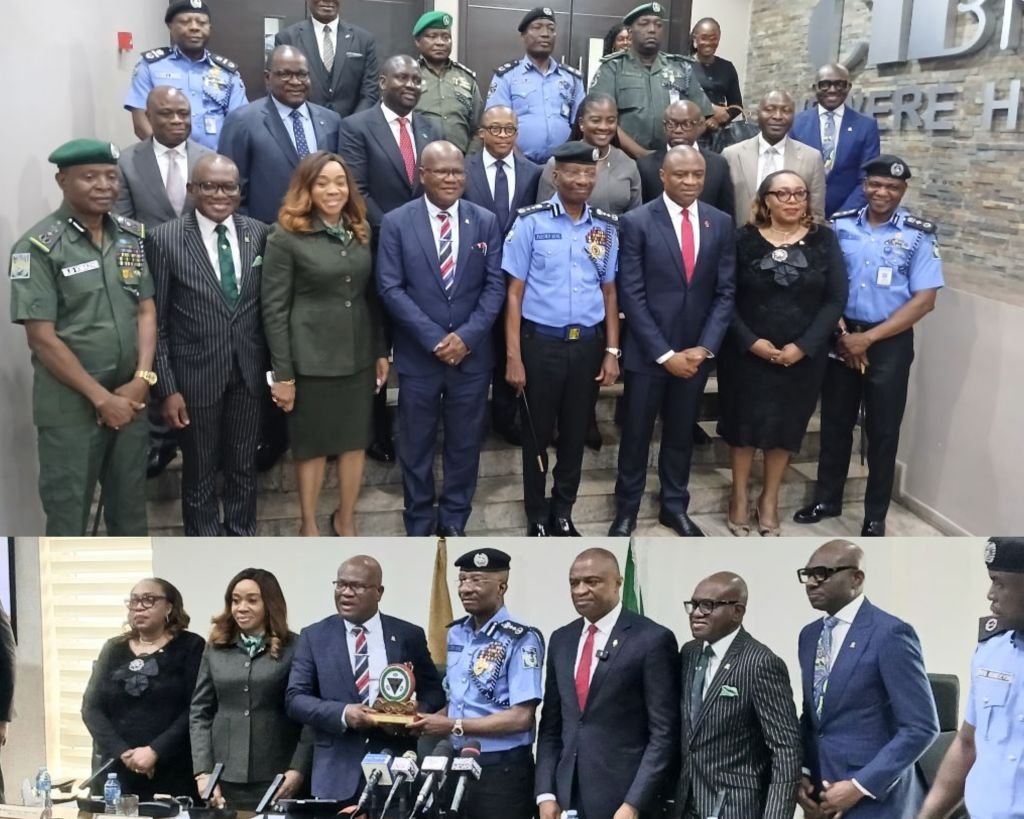
In what may prove to be a defining moment in the evolving architecture of Nigeria’s financial security framework, the Inspector-General of Police (IGP), Kayode Adeolu Egbetokun, on Thursday unveiled a far-reaching strategic shift in policing policy during a high-level engagement with the Body of Bank Chief Executive Officers at the Bankers House, Victoria Island, Lagos.
The engagement, convened under the auspices of the Chartered Institute of Bankers of Nigeria (CIBN), brought together top banking executives and senior police leadership in what stakeholders described as a historic convergence of economic and security institutions.


Addressing the gathering, Egbetokun declared that financial security and national security are now inseparable realities in an increasingly digitised and globally interconnected world.
“Whatever affects one affects the other,” the IGP said. “The protection of our financial institutions must be treated as a shared national priority.”
From Withdrawals to Deposits
Setting a reflective tone, the IGP shared a light but symbolic exchange he had while heading to the meeting.
“A friend asked me what I was going to withdraw at the bankers’ house,” he said. “I told him the police are not here for withdrawals. We are here to make deposits — deposits of stronger security, stronger collaboration, and greater confidence in the Nigerian financial system.”
The metaphor captured the essence of the meeting: a transition from reactive policing to structured, intelligence-led partnership.
Major Policy Shift on Police Deployment
In one of the most consequential announcements of the engagement, the IGP revealed that regular police officers will no longer be routinely deployed for private VIP escort duties or non-essential protective assignments within the private sector.

Additionally, the traditional model of deploying conventional police personnel for routine cash-in-transit escort services is being progressively restructured in line with manpower optimisation and international best practices.
“This policy adjustment is not designed to diminish the security framework supporting the banking industry,” he clarified. “Rather, it reflects a deliberate transition toward a more sustainable, professional, and institutionally governed model of security support.”
Under the revised framework, banks and critical financial institutions will increasingly rely on properly trained Supernumerary Police Officers (SPOs), regulated under Sections 21 to 25 of the Nigerian Police Act 2020.
The Act empowers the Nigerian Police Force to:
- Approve appointments of supernumerary personnel
- Ensure structured training and certification
- Maintain supervision and discipline
- Authorise arms bearing under regulated conditions
The reform, the IGP said, preserves core national policing capacity while maintaining professional, lawful, and accountable security arrangements for financial institutions.
Intelligence-Led Financial Infrastructure Protection
The IGP acknowledged that while traditional armed attacks on bank branches have reduced, the threat landscape has evolved significantly.
Nigeria now faces increasingly sophisticated transnational risks including:
- Cyber-enabled fraud
- Identity compromise
- Insider facilitation
- Organised financial crime
- Illicit financial flows
“These threats are adaptive, technologically sophisticated, and often coordinated across borders,” he warned.
He disclosed that the Nigeria Police National Cybercrime Centre is now rated among the best globally, citing successful joint operations with the FBI, Interpol, Europol and other international agencies.
Recent intelligence-led operations have dismantled kidnapping syndicates, degraded violent criminal networks, and recovered illegal arms — developments he described as foundational to investor assurance and commercial stability.
“These outcomes are not merely security metrics,” he said. “They are pillars of economic resilience.”
Banking Leaders Applaud Security Gains
Chairman of the Body of Bank CEOs and Group Managing Director of United Bank for Africa, Oliver Alawuba, commended the IGP’s leadership and reforms.
“We have seen that banking branches are safer under your leadership,” Alawuba said. “A safe banking industry is critical for the economy to grow.”
He noted a visible reduction in violent crimes and attacks on bank branches, describing the improvement as encouraging for business continuity.
Alawuba also praised internal reforms within the Police Force, including:
- The upgrade of the Police Medical Department to a Directorate
- Payment of ₦2.1 billion in insurance benefits to families of fallen officers
- Mentorship and inclusivity programmes
- Improved professionalism and accountability
“We appreciate the work your officers are doing, even when we are safe in our homes,” he said.
He disclosed that the banking industry has supported security institutions over the years, including:
- Upgrading 44 police facilities nationwide
- Contributing to Lagos State Security Trust Fund
Providing financial and logistical support to security initiatives in various states
“No government can do it alone,” he added. “Collaboration is essential.”
Prof. Pius Deji Olanrewaju Calls Engagement Strategic and Historic
President and Chairman of Council of the Chartered Institute of Bankers of Nigeria, Prof. Pius Deji Olanrewaju, Ph.D, FCIB, described the engagement as both historic and strategic, stressing that economic resilience and national stability are now deeply intertwined.
“At a time when national security and economic resilience are closely interconnected, this engagement is timely and critical,” Prof. Olanrewaju said.
He noted that rapid digital transformation within Nigeria’s financial services ecosystem has increased the complexity of emerging risks, particularly cyber-related threats and financial crimes.
“As financial services evolve, the security landscape becomes more complex. Addressing these risks requires sustained cooperation between law enforcement and the financial sector,” he said.
Prof. Olanrewaju reaffirmed the Institute’s statutory mandate under Section 3 of the CIBN Act 2007 to uphold professional standards within the banking ecosystem and pledged deeper institutional collaboration with the Nigerian Police Force.
In a symbolic gesture underscoring institutional goodwill, the IGP was recognised as a “Friend of the Chartered Institute of Bankers,” reflecting what the Institute described as his supportive disposition toward the banking industry.
A Strategic National Asset
Throughout the engagement, a clear doctrine emerged: Nigeria’s financial system is a strategic national asset deserving of the highest protective priority.
The IGP framed the partnership not merely as enforcement collaboration but as strategic alignment to safeguard Nigeria’s global financial credibility.
“The strength of payment systems, the stability of banking operations, and the robustness of compliance frameworks shape Nigeria’s standing within the international financial ecosystem,” he said.
He urged financial institutions to institutionalise rapid incident reporting, coordinated evidence preservation, and structured response mechanisms to counter cyber-enabled fraud.
Modern financial crimes, he warned, operate at digital speed and require equally agile security coordination.
Beyond Speeches — A Structural Recalibration
Thursday’s engagement signalled more than a ceremonial meeting. It marked a structural recalibration in the relationship between Nigeria’s law enforcement architecture and its financial governance institutions.
For the banking sector, it signals continued security support but within a more professional, regulated and intelligence-driven framework.
For the Nigerian Police Force, it reflects a repositioning toward core national priorities.
For Nigeria, it reinforces a defining principle of modern statecraft: economic stability, investor confidence and national security are interdependent pillars.
If fully implemented, the reforms unveiled at Bankers House could reshape financial security governance in Nigeria for years to come.
And as the IGP concluded, the mission is not simply enforcement but partnership in safeguarding national prosperity.
