

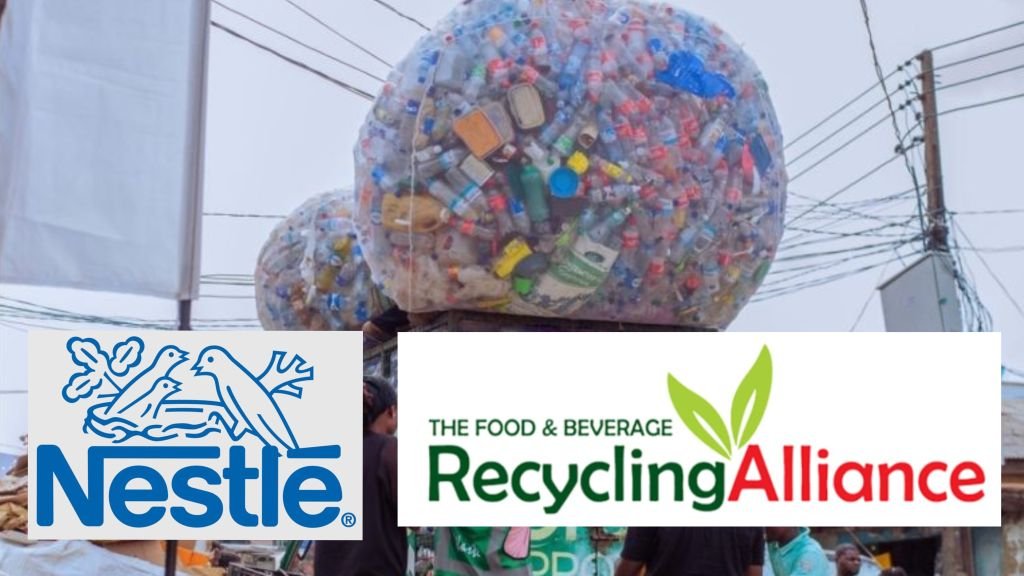
Nestlé Nigeria, FBRA Lead the Charge in Closing Nigeria’s Plastic Waste Loop
By Adebote Mayowa
Photojournalist, Creative Director, Climagraphy
As Nigeria’s population continues to grow estimated by the United Nations Population Fund to reach over 237 million by 2025 so does the volume of waste generated across the country. With over 32 million tonnes of solid waste produced annually, according to the World Bank, the pressure on city authorities and private stakeholders to develop sustainable waste management systems has never been greater.
Among the most transformative responses to this challenge is the Extended Producer Responsibility (EPR) policy, introduced in 2014 through the National Environmental Standards and Regulations Enforcement Agency (NESREA). This policy gave birth to the Food and Beverage Recycling Alliance (FBRA) in 2018, Nigeria’s first Producer Responsibility Organisation (PRO) for the food and beverage sector.
Since its establishment, FBRA has evolved from a consortium of four founding members into a robust alliance of 49 member organisations as at November 2025, collectively driving the recovery, recycling, and circular management of post-consumer packaging waste. The Alliance has successfully collected over 100,000 metric tonnes of plastic waste from the environment, redefining waste not as a nuisance but as a resource within Nigeria’s circular economy.
“While FBRA may not be a household name on the streets, its impact is visible in cleaner communities and empowered waste collectors, particularly in Lagos State,” said Victoria Uwadoka, Corporate Communications, Public Affairs and Sustainability Lead at Nestlé Nigeria.
Beyond being one of Nigeria’s largest and most trusted food and beverage companies, Nestlé Nigeria has taken a bold leadership role in environmental sustainability and waste management. The company’s approach goes beyond people and profit; it embraces planet stewardship as a core business principle.
Nestlé Nigeria was one of FBRA’s founding members and has remained one of its most active supporters and advocates. As Victoria Uwadoka explains:
“Though as producers we compete commercially, we unite as collaborators when it comes to fulfilling shared environmental responsibilities.”
This collaborative spirit has driven Nestlé’s pioneering achievements in packaging innovation and waste recovery. In December 2023, the company achieved 100% plastic neutrality, taking back every tonne of plastic it put into the market.
Furthermore, Nestlé became the first company in Nigeria to incorporate 50% recycled polyethylene terephthalate (rPET) into its Nestlé Pure Life water bottles, fully compliant with the Standards Organisation of Nigeria’s food-grade packaging standards.
Through FBRA’s framework, Nestlé Nigeria and other producers have galvanized the waste value chain, ensuring plastics are retrieved, recycled, and reintegrated into production cycles.
“The manufacturers do not produce plastics to litter the streets,” Uwadoka explained. “Consumers discard them, but through FBRA’s system, that waste is recovered, creating jobs and value.”
She added:
“Every bottle that is taken out and doesn’t end up in the ocean is one bottle less of a problem. Closing the loop is key circularity is the destination.”
The FBRA–Nestlé partnership exemplifies how industry-led collaboration can drive real impact in environmental management, proving that building a cleaner, more sustainable Nigeria is a collective effort.
