

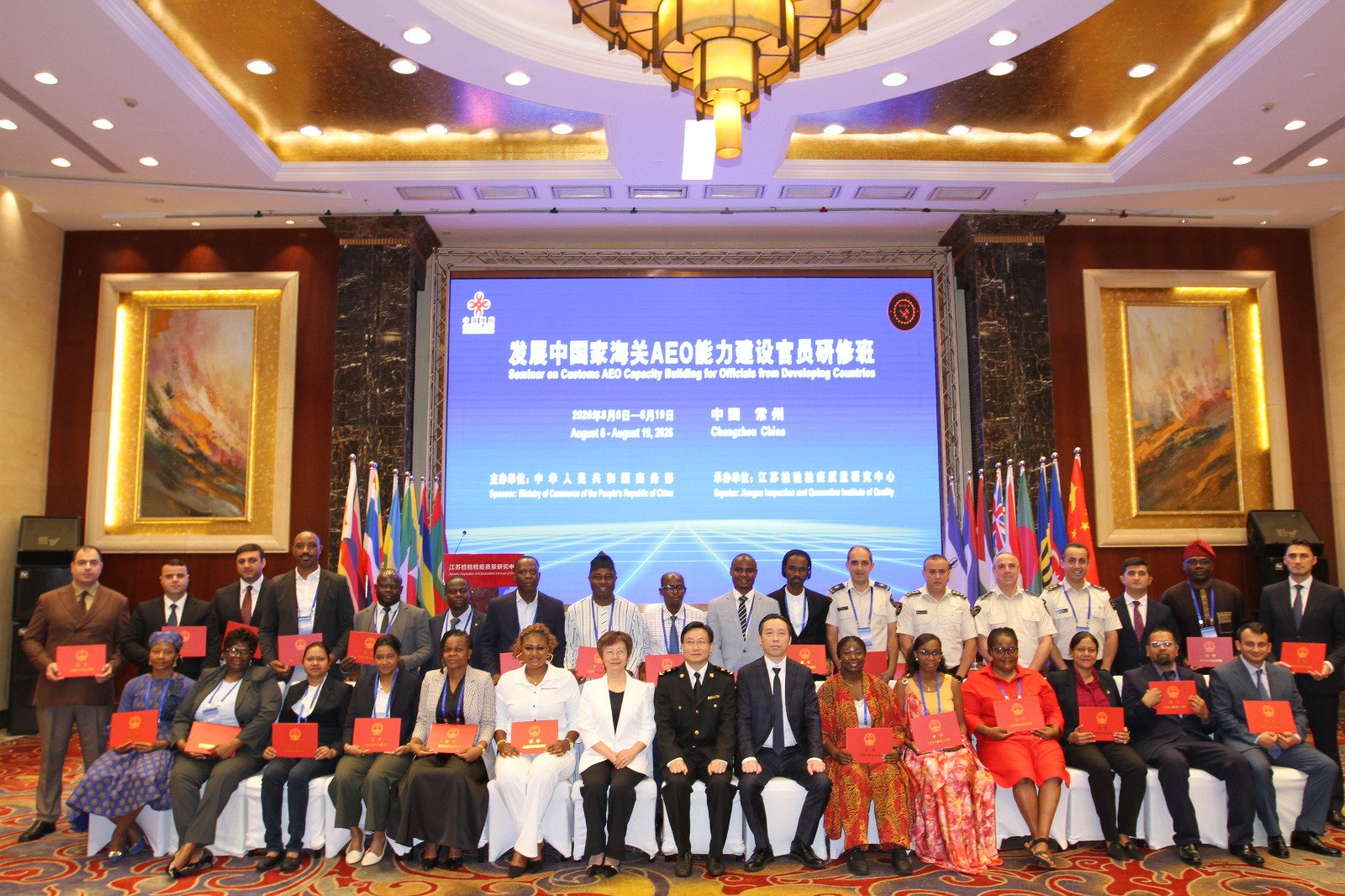
Customs Deepens Global Partnerships as AEO Team Concludes Strategic Capacity-Building Seminar in China
By The People’s Voice Nigeria News
The Nigeria Customs Service (NCS) has reaffirmed its commitment to international best practices, supply-chain security and trade modernisation following the successful participation of a five-member Authorised Economic Operator (AEO) Team in a specialised capacity-building seminar in Changzhou, Jiangsu Province, China.
The seminar, held from August 6 to 19, 2026, provided the Nigerian delegation with extensive exposure to China’s customs administration, enterprise credit management system, post-clearance audit procedures, non-intrusive inspection technologies and digital platforms supporting efficient international trade.
The programme, titled “Seminar on Customs AEO Capacity Building for Officials from Developing Countries,” was sponsored by the Ministry of Commerce of the People’s Republic of China (MOFCOM) and organised by the Jiangsu Inspection and Quarantine Institute of Quality (JSIQ), in collaboration with the Nanjing Customs District.

The engagement forms part of Nigeria’s broader efforts to strengthen its AEO programme and align the country’s trusted-trader framework with internationally recognised standards, particularly the World Customs Organization (WCO) SAFE Framework of Standards.
Nigeria’s strategic position as a major economic and maritime hub in West and Central Africa makes efficient customs administration particularly important to the country’s trade ambitions. The modernisation of the AEO framework is expected to support faster cargo clearance, stronger compliance, improved supply-chain security and enhanced revenue assurance.
The training also reinforced the long-standing economic relationship between Nigeria and China, with both countries maintaining extensive diplomatic and commercial ties.


JSIQ, established in 2005 as a scientific research institution affiliated with the Nanjing Customs District, has significant experience in international customs capacity building. The institution has organised hundreds of foreign-aid programmes and trained thousands of customs officials, technicians and international participants from countries across five continents.
The Nigerian delegation was led by Deputy Comptroller Ojo Zaccheus Ajibade and comprised Assistant Comptroller Peter Abu Katyo, Assistant Comptroller Susan Adar Fan, Chief Superintendent of Customs Dr. Samuel Kolawole Bello, and Assistant Superintendent of Customs I Eucharia Ogechi Nwafor.
The mission was undertaken under the overall programme guidance of the National AEO Lead, Assistant Comptroller NU Awa, whose strategic direction has continued to support the development and stakeholder alignment of Nigeria’s AEO programme.
During the 14-day programme, the delegates participated in technical sessions, peer-learning exercises and operational exchanges covering advanced risk-management models, compliance scoring systems, supply-chain security and AEO validation procedures.
Particular attention was given to China’s Enterprise Credit Management System, systems-based Post-Clearance Audit, non-intrusive inspection technologies, artificial intelligence-enabled cargo imaging and digital interoperability between customs and private-sector systems.
Specialised lectures were delivered by experts including Chen Yajun on China Customs’ regulatory system; Zhao Chanof Hohai University on China’s national conditions; Shi Xinjie of Zhejiang University on poverty alleviation and common prosperity; Tang Yanli of Guangzhou Customs on enterprise credit management; Han Tong of Gongbei Customs on international mutual recognition cooperation mechanisms; Qi Yifan of Shaoxing Customs on global AEO trends; and Hu Kehong on the achievements of China’s Smart Customs programme.
The team also examined the fundamental components required for an effective AEO programme, including legal and regulatory compliance, security and safety, digital integration and post-clearance audit.
According to the lessons drawn from the programme, AEO operators must demonstrate statutory integrity and a strong compliance history, while security assessments should include comprehensive physical risk mapping. The programme also highlighted the importance of Application Programming Interface (API) connectivity with national trade platforms and the use of retrospective compliance assessments to reduce unnecessary physical intervention at ports.
Delegation Visits Major Industrial Facilities
As part of the practical component of the seminar, the AEO Team undertook operational visits to a number of industrial and manufacturing facilities in Changzhou and Shanghai.
The facilities visited included Changchai Co., Ltd.; SAIC General Motors Co., Ltd.; Shanghai Zhenhua Heavy Industries Co., Ltd.; Zhujiajiao Town; AGCO (Changzhou) Agricultural Machinery Co., Ltd.; and the Changzhou Wujin District Agricultural Machinery Equipment Manufacturing Base.
The field visits exposed the delegation to automated Optical Character Recognition (OCR) gates, Terminal Operating System-to-Customs API integration, biometric perimeter-access controls and direct Enterprise Resource Planning (ERP)-to-Customs data exchanges.
At SAIC General Motors, the delegation specifically examined the AEO certification approach adapted to New Energy Vehicle manufacturers.
The practical exposure provided the Nigerian team with an opportunity to observe how customs administrations and certified businesses can integrate technology, security and compliance systems to facilitate legitimate trade while maintaining effective regulatory control.
Focus on Mutual Recognition
A major outcome of the engagement was the emphasis placed on strengthening Nigeria’s readiness for Mutual Recognition Arrangements (MRAs) with international customs administrations, particularly China Customs.
The delegation noted that successful mutual recognition depends not merely on the existence of AEO certificates but on sustained institutional trust, compatible validation standards and reliable information-sharing mechanisms.
The technical exchange therefore examined how Nigeria can strengthen its AEO architecture to support trusted-trader recognition across borders and provide compliant Nigerian businesses with greater opportunities for preferential treatment and smoother international trade.
A gap analysis comparing aspects of China Customs’ AEO system with Nigeria’s current framework identified several areas requiring further development.
Among them are the transition from delayed gate-logging processes to real-time API connections linking Customs, ports and enterprise systems; the reduction of duplicate paper-based procedures through a more integrated Single Window environment; and stronger entity-level validation of corporate security and compliance.
The delegation also examined the need for improved surveillance systems, automated security monitoring and more consistent validation of individual business entities within large corporate groups.
Lessons for Nigeria’s AEO Programme
The technical knowledge acquired during the seminar is expected to contribute to the refinement of Nigeria’s AEO operational guidelines, monitoring frameworks and automated compliance-scoring mechanisms.
The delegation emphasised the importance of translating the knowledge gained in China into practical reforms capable of improving the experience of compliant traders while strengthening customs control.
The programme also highlighted the potential benefits of integrating AEO processes more closely with Nigeria’s indigenous B’Odogwu digital platform, alongside the development of an “AEO Innovator” category designed to accommodate micro, small and medium-sized enterprises.
The proposed reforms could also incorporate smart supervision technologies, including Artificial Intelligence-enabled Non-Intrusive Inspection (NII) systems and GPS-based container tracking, to strengthen the security of green-lane operations.
AEO Contribution to Revenue and Trade Facilitation
The NCS said the AEO programme has already demonstrated measurable benefits to Nigeria’s customs administration.
In 2025, the programme reportedly contributed ₦362.79 billion, representing a 29.68 per cent increase in revenue following certification and accounting for 21.77 per cent of total NCS revenue.
The programme also recorded an average compliance rate of 85.45 percent among certified operators.
Trade facilitation indicators showed significant reductions in cargo clearance times. According to Time Release Study (TRS) results cited by the Service, average cargo clearance time fell from 168 hours to 41 hours, representing a reported 75.60 percent reduction in clearance time associated primarily with AEO status.
The lessons from China are expected to be applied to further strengthen the programme’s Monitoring and Evaluation scoring system, deepen digital integration and improve the framework for small and medium-sized businesses.
Three-Phase Implementation Roadmap
To translate the lessons from the seminar into institutional reforms, the AEO Team has outlined a three-phase implementation roadmap.
Phase One, covering the first four weeks after the delegation’s return, focuses on a comprehensive debriefing workshop, internal assessment of the knowledge acquired and submission of a formal report to the Comptroller-General of Customs identifying areas requiring local adaptation.
Phase Two, covering months two to six, will focus on updating Monitoring and Evaluation scoring tools, standardising Post-Clearance Audit procedures and refining tiered entry criteria for small and medium-sized enterprises.
Phase Three, covering months six to twelve, is expected to focus on the integration of smart technologies into Nigeria’s customs digital infrastructure and the commencement of a China-Nigeria MRA readiness study.
The proposed study would explore opportunities for closer alignment between Nigeria’s AEO registration framework and China Customs’ enterprise credit-management system.
Strengthening Nigeria-China Customs Cooperation
The seminar concluded with bilateral consultations aimed at institutionalising continuous knowledge sharing and technical cooperation between the two customs administrations.
The NCS said the knowledge and operational lessons acquired from the programme would contribute to stronger trade facilitation, improved revenue assurance and enhanced supply-chain security.
The engagement also provides an avenue for Nigeria to deepen its international customs partnerships as it continues to modernise its AEO framework and position compliant businesses to participate more efficiently in global trade.
With the continued development of its trusted-trader system, Nigeria is seeking to strengthen its role as a major trade and logistics hub in Africa while supporting the objectives of the African Continental Free Trade Area (AfCFTA).
The China seminar therefore represents another step in the NCS’s broader transition towards a modern, technology-driven customs administration in which risk-based intervention, digital information exchange, post-clearance compliance and trusted-trader partnerships complement traditional border-control measures.
