

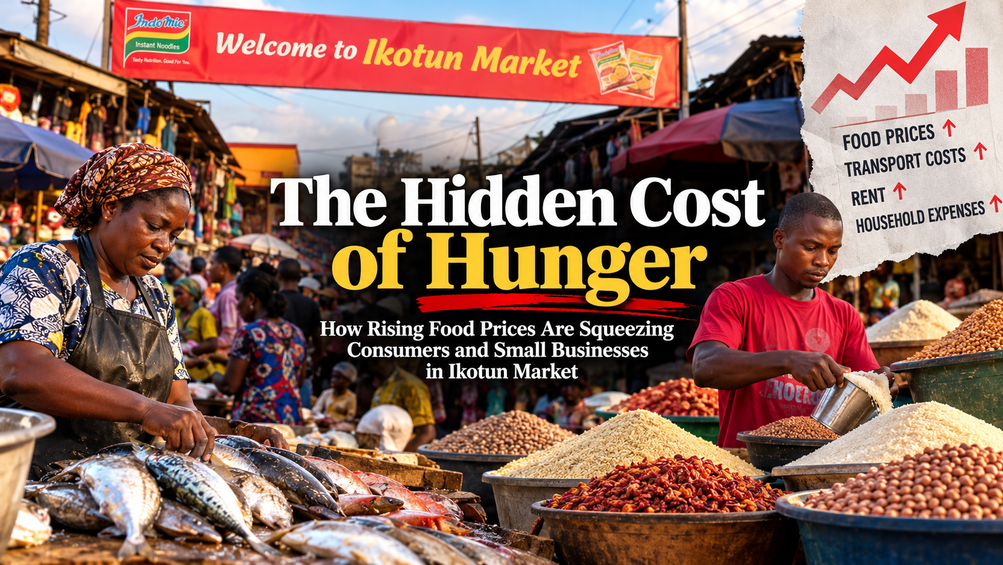
THE HIDDEN COST OF HUNGER
How Rising Food Prices Are Squeezing Consumers and Small Businesses
By Arikawe Femi | A reported feature from Ikotun Market, Lagos
A customer’s decision to choose cheaper fish is one small transaction in a bRising food prices and transport costs are squeezing household budgets and small businesses in Lagos, as consumers struggle to afford essentials.usy Lagos market. But interviews with traders and a salaried consumer reveal a wider squeeze: food purchases are shrinking, restocking costs are rising, and rent and transport leave less room in household budgets.

Ikotun Market, Lagos, where traders and shoppers are navigating rising food and operating costs. Photograph: Arikawe Femi.
A CHOICE MADE AT THE FISH STALL
At Ikotun Market, the cost of a meal can become a calculation made in seconds. During reporting for this investigation, a customer considering fish faced two price points: three Titus fish at ₦2,500 each, or ₦7,500 in total, and three Shawa fish at ₦1,000 each, or ₦3,000 in total. The difference was ₦4,500. The customer chose the cheaper option.

Fish on display at Ikotun Market. The reported price comparison in this story reflects the options offered to one customer; the fish were not weighed. Photograph: Arikawe Femi.
That brief exchange captured the central tension running through the market: people still need to feed their households, but the amount they can spend shapes what goes into the shopping bag. The choice was between two priced options on one stall, not a comparison of equal weights. Its significance lay in the decision itself and in how quickly price can shape what a shopper takes home.
The same pressure is felt by the traders on the other side of the transaction. When customers buy smaller quantities, shop owners must still find enough capital to replenish stock, pay transport and keep their businesses moving.

A shopper speaks with a fish seller at Ikotun Market. Photograph: Arikawe Femi.
WHEN THE SAME CAPITAL BUYS LESS
Isaac Ewa, owner of Zikky DeGrate Enterprise at Ikotun Market, said customers increasingly complain about prices while the money traders set aside for stock purchases buys fewer goods than before. He described customers who once bought a full paint-bucket measure of egusi now asking for half, while some rice buyers who previously purchased one or two bags ask for half or a quarter bag.

Journalist Arikawe Femi (left) with Isaac Ewa, owner of Zikky DeGrate Enterprise, at Ikotun Market. Ewa discussed food prices, transport charges and the challenge of replenishing stock. Photograph: Arikawe Femi.
Ewa recalled that a paint-bucket measure of egusi cost about ₦6,000 to ₦7,000 earlier in 2026. For purchases he described on Friday, 23 October, he put the price at about ₦11,500 to ₦13,000. For his customers, that means either spending more for the same measure or reducing what they buy.

Reported egusi prices and the fish-stall price comparison recorded during field reporting. Egusi prices are attributed to Ewa; fish quantities were not weighed.
Transport adds to the pressure. Ewa said moving a full bag of beans from Northern Nigeria to Lagos had cost about ₦1,000 in an earlier period, rising through ₦1,500 and ₦2,000 before reaching as much as ₦8,000 in charges he encountered during October. For a trader operating on limited working capital, higher freight costs are money that cannot be used to buy additional stock.
He said the combined cost of purchasing and transporting goods was making business harder and left him doubtful about making a profit that month. His experience points to a familiar squeeze in small retail: when replacement stock becomes more expensive, the same capital buys fewer goods, while customers resist passing every increase on to their own household budgets.
In written responses provided for this report, Akinola Olumuyiwa, an economist and teacher, explained that food often passes through several stages between farms and retail stalls, with transport, loading, handling, storage and possible spoilage adding to the final cost. When these expenses rise, he said, traders may increase selling prices or absorb some of the additional cost through thinner margins. The accounts from Ikotun illustrate both sides of that pressure: shoppers resist higher prices while sellers struggle to replace stock.
SMALL PACKS, SMALLER MARGINS
Ijeoma Nkiru, owner of Vine Ventures, whose natural-spice business operates under the name Litany of Natural Spices, said transport costs for comparable arrangements had risen from ₦5,000 to ₦15,000. Many of the spices she sells including pepper-soup seasoning, Uda, Uziza seeds, Gorontula, Cinnamon and other ingredients come from Northern Nigeria, making the cost of moving products part of the business equation.
She said some regular customers who once visited three or four times a week now sometimes come once or twice. To accommodate tighter budgets, she offers small quantities, including ₦200 and ₦300 packs of some spices, and at times accepts smaller margins to keep customers buying.
“Salary did not increase but foodstuff is increasing,” Nkiru said, describing the squeeze she also experiences as a mother of four. She said she remains in business but earns less than she did previously. Her account shows how traders can respond by changing pack sizes and margins rather than simply increasing prices, while still trying to preserve customer relationships.
Mr Chucks, who runs Chuck Provision Store at Ikotun, described a similar challenge in replacing stock. He recalled that money that once bought several cartons of provisions now buys much less. Citing Milo 3-in-1, he put a recent carton price at about ₦38,500 to ₦40,000 and remembered an earlier price in the ₦20,000 range. Because the earlier date and carton specification were not established, the comparison is best read as his recollection rather than a like-for-like price series.

Provisions on display at a small retail shop in Ikotun Market. Photograph: Arikawe Femi.
Taken together, the traders’ accounts show how higher replacement costs and customers’ tighter budgets can collide. The interviews do not establish a market-wide profit trend, but they document the practical adjustments these business owners describe: smaller customer purchases, smaller packs, and pressure on the money available for restocking.
Olumuyiwa stressed the difference between revenue and profit. A higher selling price does not necessarily mean a trader is earning more if the cost of replacing inventory has risen and customers are buying fewer units. When more cash is needed to replenish stock, slower sales or smaller purchases can leave less working capital available for transport, supplier payments and other operating expenses.
THE HOUSEHOLD BUDGET BEYOND FOOD
For a salaried consumer who asked to be identified as Miss Adejoke, the cost-of-living squeeze extends beyond the market. She said she earns ₦243,000 a month, work on the island, reside in Ikotun on the mainland and that her annual rent rose from ₦450,000 in 2025 to ₦600,000 in 2026, an increase of ₦150,000, or about 33.3 percent.

Miss Adejoke’s reported annual rent: ₦450,000 in 2025 and ₦600,000 in 2026. Individual household account.
On a simple monthly-equivalent basis, the new annual rent represents ₦50,000 a month, compared with ₦37,500 under the previous rent. That is a comparison for analysis, not a claim that she pays rent monthly. She also said that if she misses her staff bus, getting to work can cost ₦2,500 to ₦3,000, excluding feeding. She did not describe this as a daily or monthly average.
Adejoke said her salary can run short within days of payday after she buys food for the home and meets the costs of maintaining the appearance expected at work. At times, she borrows money to get through the remainder of the month. She worries that workers supporting children and other dependants may face even greater strain as food, housing and transport compete for the same income.
WHAT THE INFLATION FIGURES REVEAL
The official figures provide a wider context for these individual accounts. The National Bureau of Statistics reported that Nigeria’s headline inflation rate stood at 14.63 percent in September 2026, down from 15.39 per cent in August. Year-on-year food inflation was 19.59 percent, while Lagos recorded the highest state-level year-on-year food inflation rate, at 34.40 percent. These are index-based measures of price change, not a claim that every food item rose by the same percentage.

Nigeria’s headline inflation, national food inflation and Lagos food inflation, all year-on-year rates for September 2026. Source: National Bureau of Statistics (NBS), Consumer Price Index, September 2026, pp. 6, 10 and 16.
A lower annual inflation rate does not mean prices have returned to earlier levels; it means the rate of increase has slowed compared with the relevant comparison period. The NBS report also recorded national food inflation of -1.55 percent month-on-month in September 2026. That monthly decline can coexist with a much higher food-price index than a year earlier, helping explain why households may continue to feel pressure even as the annual rate falls.
The national and Lagos figures measure price movements across defined baskets, not the exact price of every item in Ikotun Market. They do not by themselves explain the cause of any individual price change. The field interviews provide a different kind of evidence: traders describe higher costs and changing customer behaviour, while a salaried worker describes food, rent and transport competing for the same income. Together, the data and accounts frame the affordability problem without treating individual experiences as national averages.
Olumuyiwa said the practical response should focus on reducing avoidable costs between farms and consumers. He identified better rural roads and transport corridors, more efficient logistics and strategically located food aggregation centres as priorities that could support bulk transportation and coordination between producers and traders. He also cautioned that such facilities would need transparent management and affordable access for small businesses; infrastructure alone cannot resolve every pressure on household budgets.
The market observations also raise a nutrition question: when budgets tighten, do families simply buy less food, or do they substitute among foods, reduce quantities or leave some items out? The fish purchase observed for this story is one example of a price-driven choice. The broader concern is whether households can consistently afford a varied diet after meeting other essential expenses.
Olumuyiwa said households under pressure may reduce quantities, skip meals or substitute cheaper foods. Some substitutions can still provide a balanced diet, but severe financial constraints can narrow dietary diversity and make it harder to obtain sufficient protein, vitamins and minerals. These are potential risks, rather than outcomes established for every household interviewed in Ikotun.
BEYOND FOOD: HOUSEHOLD PRIORITIES AND NUTRITION
The effects of household pressure also reach beyond food stalls. Iya Bimpe, a clothing trader interviewed during the earlier reporting, said customers increasingly postpone clothing purchases as they prioritise more immediate needs. Her account suggests that household spending choices can affect small businesses outside the food trade as well.
Mrs Daniel, a teacher and mother, described the effort involved in planning meals around a household budget. Her account brings the discussion from the market into the home: even when a family manages to buy food, it must still decide how much variety and which ingredients it can afford.
A healthy diet involves more than buying enough food to fill the stomach. The National Bureau of Statistics tracks the Cost of a Healthy Diet separately, estimating the least expensive combination of locally available foods that meets dietary guidelines. The measure is expressed as a lower-bound cost per adult per day and excludes transport and meal preparation. When money is tight, the question is whether households can afford a varied diet consistently after paying for housing, transport, school needs and other essentials.

Traffic and trading activity around Ikotun Market. Photograph: Arikawe Femi.
A BUSINESS AND PUBLIC-POLICY CHALLENGE
The accounts collected in Ikotun point to several areas for policy attention. More reliable transport and better-maintained roads may reduce delays and vehicle costs; storage, cold rooms and processing facilities could help limit post-harvest losses. Stronger links between farmers and urban markets, transparent market charges and accessible price information could improve coordination. Small retailers also need appropriately designed working-capital finance, while safeguards should prevent borrowing from becoming an additional burden.
Olumuyiwa recommended improving rural roads and transport corridors, investing in storage and cold-chain facilities, strengthening links between farmers and urban markets, reviewing duplicated or opaque market charges, and expanding carefully designed working-capital finance for micro and small businesses. He also highlighted price information and targeted support for vulnerable households. These are proposals offered by the respondent, not interventions evaluated by this field report.

Traffic and trading activity around Ikotun Market showing commuters. Photograph: Arikawe Femi.
Households also need incomes and support systems that make nutritious food more attainable. Nutrition education can help families make informed choices, but advice alone cannot remove the barrier created when a recommended food is unaffordable. Schools, health professionals, community organisations and government agencies can contribute, provided initiatives are designed around evidence and the needs of vulnerable households.
Policy options such as import changes or subsidies should be evaluated against evidence on affordability, domestic production, supply reliability and the effects on farmers and consumers. Ewa expressed the view that greater availability of imported rice could make rice cheaper; that is his opinion, not a demonstrated policy outcome in this investigation. Any such proposal requires independent economic analysis.
THE HIDDEN COST IS NOT MEASURED IN CHOICE
The story that began with a customer choosing cheaper fish leads to a wider picture of adjustment. A foodstuff trader says customers ask for half a measure instead of a full one. A spice seller offers smaller packs and accepts tighter margins to retain customers. A provisions retailer says his capital no longer buys the quantity of stock it once did. A salaried consumer describes rent, transport and food competing for the same pay.
These are individual accounts, not a survey of every trader or household in Lagos. Read alongside the official inflation figures and Olumuyiwa’s economic analysis, however, they show how wider price movements can translate into everyday decisions about quantities, stock replacement and household spending.
The hidden cost of hunger is not only what a household spends. It is also the range of choices that remain after rent, transport and other essentials have been paid. When families repeatedly adjust what they buy and how much they buy, the question is not merely whether food is present on the table, but whether they can consistently afford a varied diet that supports health and wellbeing.
At the fish stall, the difference between the two options was ₦4,500. For one customer, that difference shaped a single decision. For the traders and households interviewed for this report, the pressure is cumulative: making each naira stretch across food, transport, rent and the next day’s needs. Their accounts put a human scale on an economic question that headline figures alone cannot fully answer.
